VR Greenland
A VR serious game visualizing Greenland's glacial retreat: pilot a polar research vessel — work the helm, rig the sails, scout with a drone, and run ocean-science sampling to uncover the story of a warming Arctic.
Role
Game Designer / VR Interaction Designer
Engine
Unity
Team
Individual project
Duration
2026
Overview
VR Greenland is a serious game that turns the abstract data of climate change into a hands-on polar expedition. The player captains a research sailboat through Greenland's fjords, and every action — steering, rigging, scouting, sampling — feeds back into a scientific picture of how the ice sheet has retreated over more than a century.
The experience runs on two interlocking layers:
- Macro map mode — a desktop-sized diorama sandbox. A staged, adjustable prototype visualizes the glacier's retreat; the player sets survey waypoints, plans a voyage, and collects water and biological data. Findings unlock in-world news and achievements, and a milestone system tracks scientific progress made in the embodied mode.
- Embodied mode — entered from a chosen retreat stage on the macro map, this is the first-person VR sailing and science experience built from four interaction modules.
Embodied Mode — Four Interaction Modules
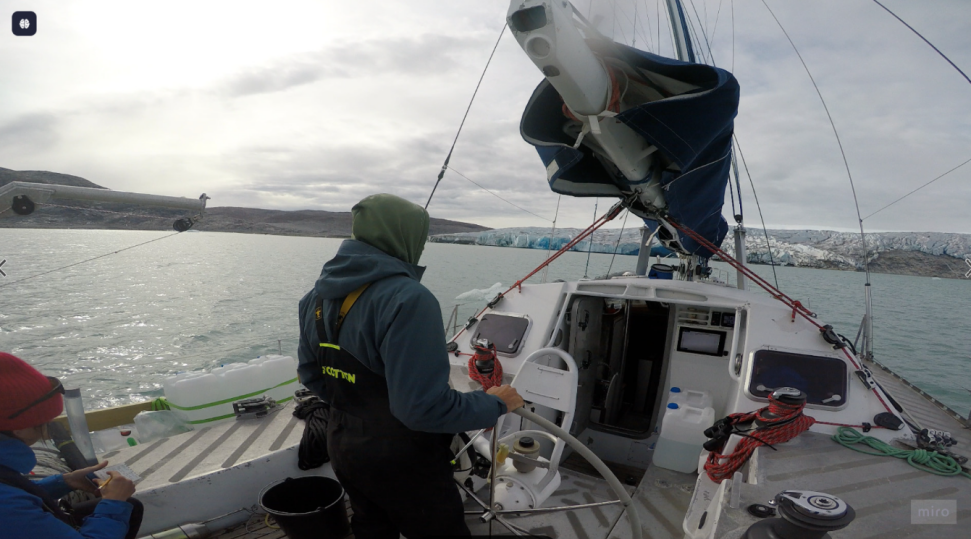
Module 1 · The Cockpit Layer (helm & power). The player reaches out in VR and grabs the oversized ship's wheel 1:1; twisting it triggers fine controller haptics that simulate the drag of water against the rudder. A mechanical throttle lever sits to the right — when drift ice appears, the player throws the helm hard to port with the left hand while pushing the throttle with the right to complete an emergency avoidance.
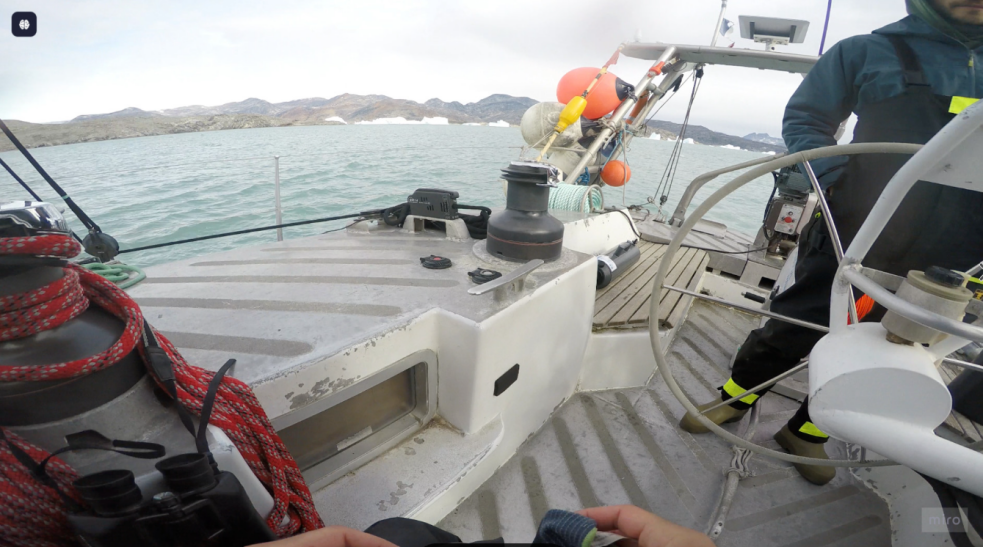
Module 2 · The Rigging Layer (manual winch & sails). Raising speed requires a multi-step interaction: physically pick up the coloured lines, wind them clockwise onto the winch, insert the winch handle, and crank in an alternating "windmill" motion to trim the sail. In strong-wind zones the player drops the mainsail and starts the engine; in steady-wind zones they adjust the lines on both sides of the hull to change the sail's angle and pick up speed.
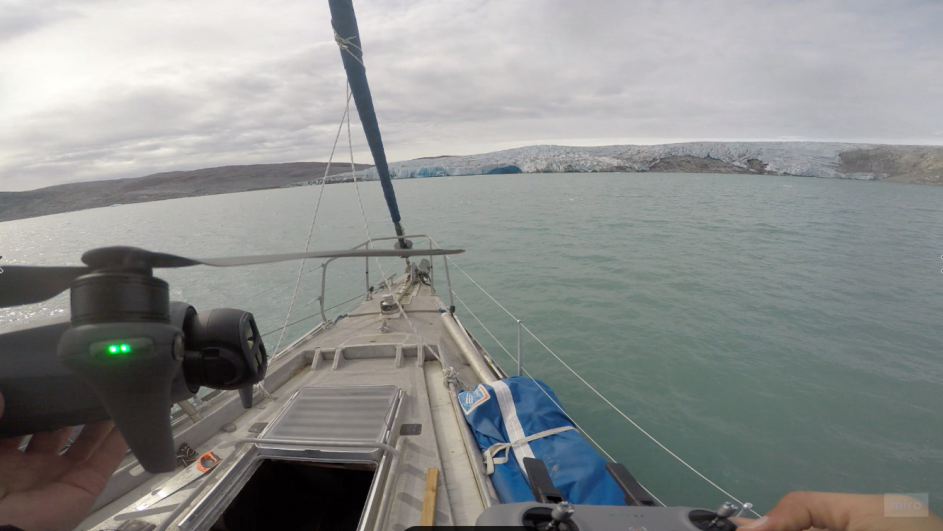
Module 3 · The Drone Scouting Layer. When the radar alarm sounds and a giant iceberg blocks the line of sight, the player takes a virtual remote from their waist. The view switches to a drone FPV / picture-in-picture UI, flying over the Greenland ice to mark a safe fluorescent channel for the sailboat through the cluttered ice sea.
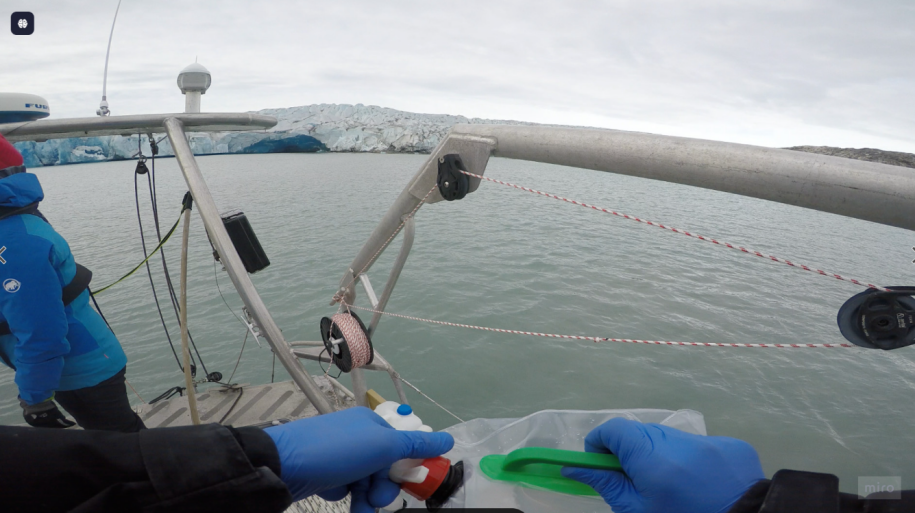
Module 4 · The Science Sampling Layer. The game shifts into a research sub-mode: the player pulls on virtual sterile blue gloves, works the stern's mini davit winch, and lowers a sampling bag or CTD array into the polar-green water while salinity and chlorophyll readings tick across the console. Sampling covers seawater extraction (dissolved composition, isotope analysis), CTD profiling of the water column, seabed sediment cores, and plankton captures.
The Sampling System
Three sampling tools each yield data that can trigger special narrative events:
- CTD Rosette — load Niskin bottles into the 8-slot Rosette frame, open the caps, winch the assembly to the seabed, then trip bottles at stepped depths on the way up. The Science Console reads depth, pressure, conductivity (salinity), temperature, chlorophyll fluorescence and dissolved oxygen; back on deck, an analyzer reports the stable δ¹⁸O/δ¹⁶O ratio, nutrients (N, P, Si), bioavailable iron and dissolved organic carbon.
- Sediment Corer — a coarse layer of ice-rafted debris (IRD) in the core reveals a year when icebergs drifted over and melted; Mg/Ca ratios in foraminifera shells back-calculate the ancient seawater temperature.
- Plankton Net — species abundance, biomass, C/N ratio and shell damage. Thinning or acid-etched pteropod ("sea butterfly") shells directly demonstrate CO₂-driven ocean acidification; a surge of warm-water plankton confirms the "warming and Arctic-borealization" of Greenland's waters.
Backdrop — Four Stages of Retreat
The macro map's staged prototype is grounded in the real timeline of the Greenland Ice Sheet:
- Slow response to early industrialization (1900s–1970s) — greenhouse-gas accumulation ends the "Little Ice Age" growth; the glacier begins a slow, fluctuating retreat.
- The North Atlantic "cold blob" & plateau (late 1970s–early 1990s) — a relatively stable plateau, with brief cooling and increased snowfall in some southern regions, driven by local ocean-current shifts.
- Full imbalance & accelerated melt (1996–early 2010s) — a turning point: from 1996 the ice sheet loses dynamic balance, snowfall can no longer offset summer melt and calving, and loss spikes exponentially.
- Extremes & the edge of "irreversible" (mid-2010s–present) — melting shifts from "seasonal event" to "normalized and extreme"; even under reduced-emission assumptions, the retreat is effectively locked in.